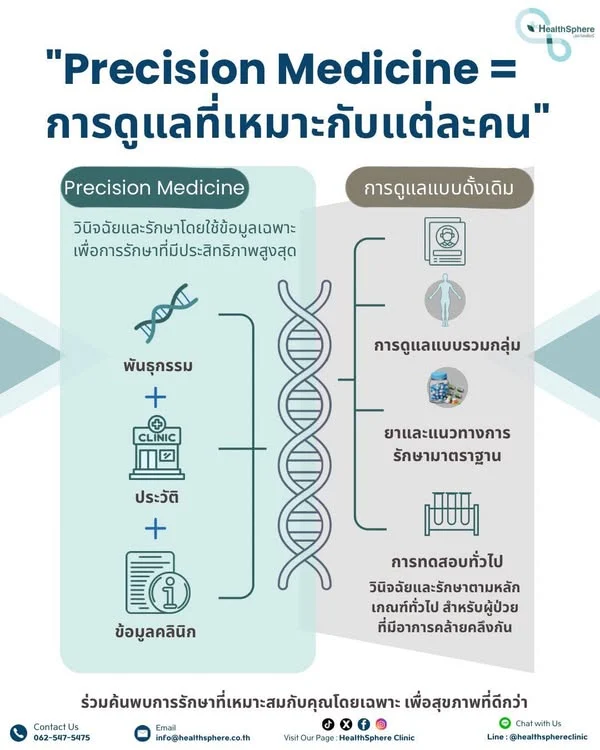
The clinic's precision-medicine post describes care informed by individual differences in genes, environment and lifestyle. The term does not promise certainty from every test or a guaranteed treatment outcome.
Individual care begins with history, current conditions, medicines, family history and personal priorities. It does not require everyone to buy a large DNA panel. Ask what clinical question a proposed test addresses and how its result could change care.
Genetic information may help assess a suspected inherited disorder or guide use of certain medicines when indicated. Results need clinical context: a genetic risk is not a prediction that disease will definitely occur.
Ask what the test cannot detect, what a negative result means and whether uncertain findings or information about relatives could arise. Confirm who interprets results and what counselling is available afterwards.
Genetic data are sensitive. Discuss consent, sample storage, data retention, access and any additional use. Confirm the full costs rather than relying on a claim that a product is personalised.
Review consumer genetic results with a clinician before changing medication, diet or follow-up. Some findings need clinical confirmation. Useful precision medicine combines an appropriate question with informed choices about benefits, limits and privacy.